How to Increase Profit on Your Shopify Store: Lessons From Squashed Pixel
by Edward Upton
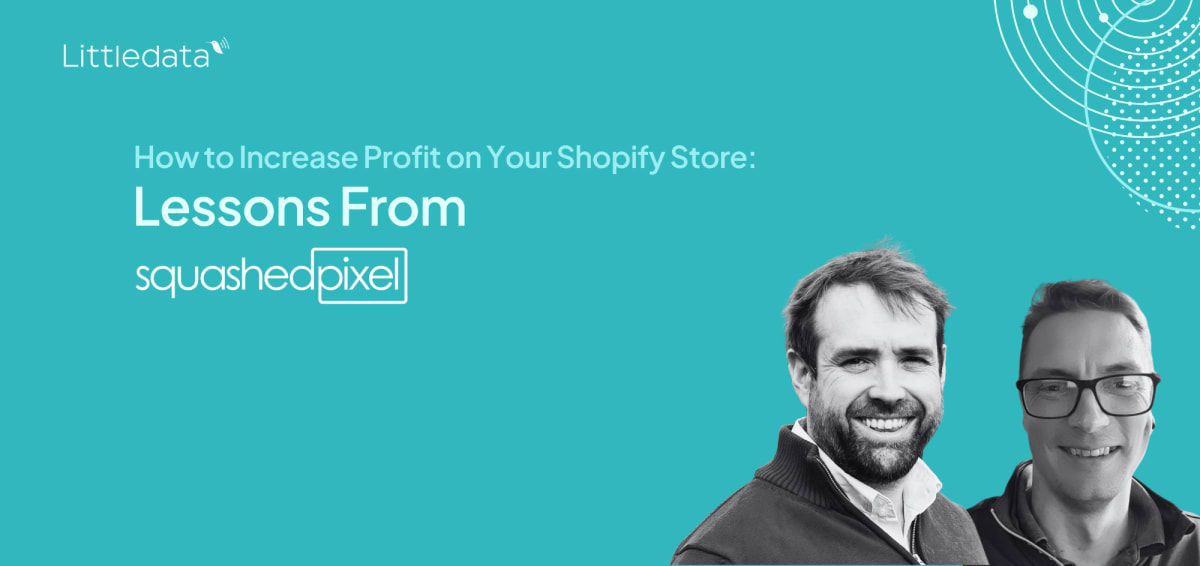
On the latest episode of The Littledata Show, Tom Gatenby of Yorkshire Shopify agency Squashed Pixel explains where profit actually comes from on a Shopify store: fewer apps, honest channel data, and squeezing more from the channels you already pay for.
Key takeaways from the conversation:
- Audit your apps first. Stores commonly pay for 25 apps while actively using four, and every unused app costs money, page speed, and reporting accuracy.
- Blended conversion rates mislead. A 3% store average can hide a 0.3% Meta rate and a 6% organic rate; only channel-level attribution shows where the problem is.
- Dead spend hides behind good headlines. One brand found 80% of its Meta budget was going to non-performing ads once its tracking was fixed.
- Microsoft Ads is undertracked, not underperforming. Littledata typically records four to five times more Microsoft Ads conversions than Shopify's free channel app reports.
The post-COVID era of "deploy cash, count later" is over. Every penny is counted, and brands want profit, not headline revenue. Tom has been building on Shopify since the platform's early days, and his agency now spends most of its time helping brands find margin they didn't know they were losing. Here's where he starts.
Start with a Shopify app audit
The first lever is rarely a redesign. It's an app audit. Tom's team regularly inherits stores running 25 apps where only four are in active use. The rest still cost money in three ways: subscription fees, slower page loads, and inflated reporting. Each app claims a slice of the conversion credit, so every tool looks like it's performing even when it isn't.
Cutting the list down to five or six fundamental apps is usually a direct cost saving. It also produces a truer picture of site speed. Tom's view on Core Web Vitals is pragmatic: there is an element of being "fast enough". An app like search personalization may slow the page but lift conversion enough to pay for itself. The point is to make that trade-off consciously rather than pay for apps nobody remembers installing.
Google Tag Manager deserves the same scrutiny. Containers accumulate tracking scripts for tools the business stopped using years ago, usually added by someone who left without documenting why. Nobody removes them for fear of breaking something. That fear is a hidden maintenance cost: someone has to keep the data layer accurate, benchmarks keep shifting, and it's not a fun job for anyone. Brands that don't want to own that job should at least know they're paying for it in slower pages and stale data.
Shopify total cost of ownership vs WooCommerce and Magento
For brands weighing a migration, Tom's argument isn't that Shopify is cheaper. Worked out end to end, the total cost of ownership against WooCommerce or Magento comes out roughly on par once you factor in hosting, SSL certificates, patching, and the downtime when one plugin breaks fifteen others. The difference is where the money goes.
On a self-hosted platform, a large chunk of the budget maintains the status quo. One Magento brand spent two years of its entire agency budget migrating to the latest version, with zero operational improvement to show for it. Security-wise it was necessary. Commercially it moved nothing. On Shopify, that same budget shifts to conversion rate work, content, and ads. The spend becomes growth-oriented instead of keeping the website alive, and the brand regains control of day-to-day changes. Adding a banner or moving content no longer needs a six-week development rollout, so being reactive starts to make sense.
Downtime is the cost brands forget. Tom recently spoke to a Magento merchant who was offline for three days after a broken patch. The lost sales never appear on the balance sheet, but the ads kept running into a dead site, emails kept sending, and support costs spiked as customers phoned in orders and chargebacks jumped from shoppers who assumed the broken site was a scam. By contrast, Shopify's rare outages are measured in hours across seventeen years.
Why your blended conversion rate is misleading
The metric Squashed Pixel cares most about is conversion rate, but never as a single blended number. A store can average 3% while Meta sits at 0.3%, organic at 6%, and Google Shopping at 4%. Brands panic at the blended figure when four of five channels are performing well and one is dragging everything down. Seen by channel, the same data turns a worry into an opportunity: fix the weak channel and the whole picture improves.
That only works if channel attribution is accurate. A low conversion rate on one channel can mean three different things: a product-fit problem, a tracking problem, or simply a colder audience. A Meta click will rarely convert like an email click, because the email subscriber is already warm. Real buying behavior involves an ad, a video, a Reddit thread, and three emails before checkout. When Edward's team worked on the made.com furniture business, the average was 17 touchpoints per purchase, because nobody clicks one ad and spends £2,000 on a sofa. High-consideration products need multi-touch attribution; without it, you're flying blind.
The same caution applies when adding channels. There's an assumption that 2,000 visitors from Google Shopping will convert like 2,000 visitors from anywhere else. They won't, and you need channel-level measurement in place before you can even see the difference.
Dead spend looks like good spend
One brand the two teams share is the clearest example. When Squashed Pixel took them on, roughly 60% of revenue was completely unattributed, yet Meta and Google Shopping reports looked great. The platform numbers never reconciled with actual order values. Once the tracking was fixed, the brand discovered that of the ten Meta ads running, only two were performing. Around 80% of ad spend was dead spend, hidden behind a healthy-looking headline figure.
Tom's point is that the saving itself is the smaller prize. Reallocating that budget to the two campaigns that were actually working, and to conversion rate improvements on the site, compounds the gain. Blending everything into one customer acquisition cost hides this: the brand was making money on each order, so nobody looked closer. A lower CAC also means the same budget scales further, and spreading spend across channels reduces the risk of Google moving the goalposts on a store that gets 80% of its business from one source.
Microsoft Ads: the undertracked channel
The lesson extends to channels brands have written off. Microsoft's inbuilt Shopify tracking undercounts badly: Littledata typically tracks four to five times more conversions on Microsoft Ads than the free channel app reports, compared with around 30% more for Google. Many brands tried Bing, saw a poor return on ad spend that was really a tracking artifact, and gave up on a channel that can undercut Google on cost per click. The Bing audience skews older and is bigger in the US, but it isn't shrinking, and with accurate tracking the end-to-end return can rival or beat Google for the same creative.
The wider pattern is FOMO-driven channel expansion. Brands see competitors on TikTok or the latest ad network and feel obliged to follow, without knowing whether the channel works for their products at all. TikTok does work well for some of Squashed Pixel's clients, but specifically as a combination of organic content plus ads boosting it; ads without content underperform. One client built a £5–6m business on organic TikTok alone before touching paid at all. The channel mix should follow the data, not the competition.
Squeeze the channels you already have
The instinct when growth stalls is to add a channel. Tom's experience points the other way: a new channel costs setup time, creative time, and months of experimentation, with no guarantee the conversion rate carries over. Getting the data right on an existing channel can recover 20–30% of efficiency from budget already committed. Passing gross margin back to Meta and Google, as Littledata's ProfitSignal does, pushes that further, because the ad platforms can then optimize for the profitable product mix rather than raw revenue. Meta now has a profit optimization flow built in; the missing piece for most brands is simply getting cost data into it, whether synced from Shopify or entered as a margin percentage.
Retention deserves the same realism. Re-engaging existing customers is cheaper than buying new ones, and retention marketing has rightly taken priority in recent years. But there's a ceiling. Tom has had the "let's drop paid and put everything into retention" conversation with many agencies, and the answer is always the same: you still need to feed the pot.
How to increase average order value on Shopify
If traffic is paid for, the cheapest profit lever is getting each visitor to spend more. Tom's most reliable quick win is shipping communication. Free-shipping countdown banners are on every major store for a reason: if a shopper knows they're £4 short of free shipping, adding an item is a no-brainer. People don't read, but they do watch a bar fill up. Even brands that can't afford free shipping can sell speed instead; one Squashed Pixel client offers next-day delivery for a few pounds extra above a spend threshold, turning a cost into a selling point. Beyond shipping, personalization tools that feed shoppers more of the right products, based on lookalike behavior and purchase history, lift average order value further, especially once that data feeds back into ads and email.
Bot traffic is skewing your marketing data
A newer threat to data accuracy came up late in the conversation: bot traffic on storefronts and checkouts. Much of it is competitor intelligence, scraping prices and shipping rates, but it creates fake Klaviyo profiles and audiences that can never purchase. At surface level it looks convincing, because bots enter real addresses to reach the checkout. The giveaway is the missing journey: sessions that appear and disappear with no behavior behind them. Littledata's bot protection filters this out, and the Monitor.ai product now scans recent abandoned checkouts daily to tell merchants whether they were genuine shoppers or fakes. Skewed inputs make every downstream decision worse, so this belongs on the same audit checklist as apps and tags.
Why agencies care about one source of truth
Asked why accurate data helps his agency win and retain clients, Tom's answer was trust. Most analytics platforms try to replace the data, leaving merchants with yet another dashboard claiming to be the truth alongside Klaviyo, Meta, and Google. Squashed Pixel prefers the opposite approach: fix the data at the source so the right numbers flow into every channel, then let each team work from them. His agency doesn't run the performance marketing or the email, but sits between those teams as the consolidation point, and that only works when the underlying data reconciles.
The commercial argument lands hardest with founders. Running Littledata's audit tool on a store shows the revenue impact of fixing tracking before changing anything else on the website, which moves data accuracy out of the cost bucket a finance director might cut and into the growth bucket. When every team defends its own numbers, the paid team optimizes for paid, the email team optimizes for email, and nobody optimizes for the business.
The takeaway
Every specialist team defends its own dashboard, and every dashboard claims credit. Tom's fix is structural rather than political: reconcile everything back to Shopify orders and revenue, the numbers that actually hit the bank account. When the paid team, the email team, and the agency all trust the same source of truth, the arguments about whose number is right stop, and the work of finding profit starts.
Frequently asked questions
How can I increase profit on my Shopify store without more traffic?
Start by auditing installed apps, since stores often pay for 20+ apps while using a handful, and each unused one costs fees and page speed. Then raise average order value with free-shipping thresholds and countdown banners, and reallocate ad budget away from non-performing campaigns.
Is Shopify cheaper to run than WooCommerce or Magento?
Total cost of ownership usually comes out roughly on par once hosting, security, patching, and downtime are included. The difference is that self-hosted budgets go to maintenance while Shopify budgets can go to conversion, content, and ads.
Why does my Shopify conversion rate look low?
A blended conversion rate mixes channels with very different intent, so a 3% average can hide a 0.3% paid social rate and a 6% organic rate. Break conversion down by channel with accurate attribution before deciding anything is broken.
Are Microsoft (Bing) Ads worth it for Shopify stores?
Often yes, because the poor results many brands saw were a tracking problem rather than a performance problem. Shopify's free Microsoft channel app typically reports four to five times fewer conversions than server-side tracking records, and Bing clicks usually cost less than Google's.