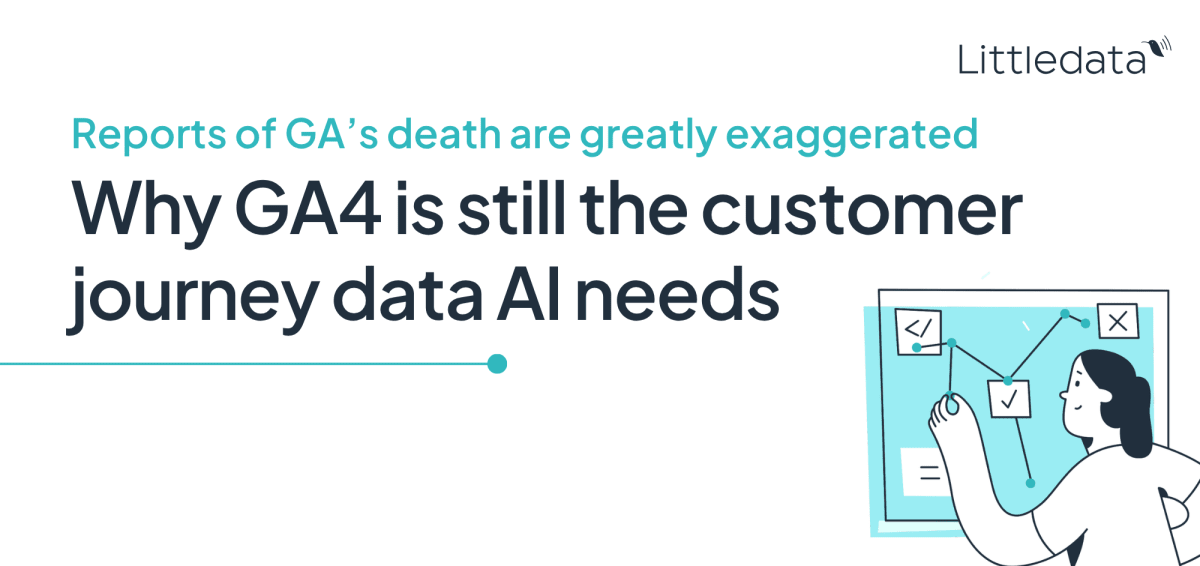
Reports of Google Analytics' Death Are Greatly Exaggerated
by Edward Upton
Shopify Analytics and paid attribution tools have taken ground from GA4. But most ecommerce stores still run Google Analytics, and it remains the only free, open store of customer journey data that AI tools can query. Here is why it is not dead yet.
This week on a podcast I got asked the inevitable question:
"Who really uses Google Analytics any more?"
I'm well known for being a GA4 advocate for ecommerce brands, so I get asked this a lot. Let me set out why Google Analytics isn't dead yet.
Who still uses Google Analytics?
Almost everyone, if you count tags on the page. W3Techs finds Google Analytics on 83% of websites with a detectable analytics tool. StoreInspect's 2026 State of Shopify report puts GA4 on 85% of the 915,000 Shopify stores it scanned.
I looked at Littledata's own database of Shopify brands with $10M+ in annual revenue, to see how the picture has changed:
| Tool detected on site | End 2021 | End 2023 | End 2025 | Now |
|---|---|---|---|---|
| Google Analytics | 72% | 77% | 80% | 80% |
| Triple Whale | 0% | 6% | 12%* | 16% |
| Northbeam | 0% | 2% | 4% | 4% |
* BuiltWith improved its detection of the Triple Whale pixel in 2026, so the end of 2025 figure is an estimate. The raw detection data shows 7%.
Google Analytics implementation has grown among large Shopify brands, and the paid attribution tools have grown alongside it. Almost every brand running Triple Whale or Northbeam still has Google Analytics installed as a backup or for different kinds of analysis.
So the question is not whether brands have Google Analytics. It is whether they still open it.
What are the alternatives to Google Analytics?
I feel GA4 has lost ground to two alternatives over the last few years.
Firstly, to Shopify Analytics, which has continued to improve in terms of reporting flexibility, charting, drill-down and marketing attribution. Yet Shopify Analytics still has some major limitations for marketing attribution:
- Shopify only — it cannot track non-Shopify sites or mobile apps.
- No data-driven attribution — there is no multi-touch attribution modelling.
- No session export — you cannot get the session data out.
- No advanced settings — no control of bot protection, internal traffic filtering, or in fact any advanced configuration.
The second alternative is a paid attribution tool, like Triple Whale or Northbeam. These provide much more ready-made reporting and metrics, but as a brand you're locked into their system. There's no data export or off-ramp if you outgrow the tool, or a new team or agency doesn't like working with it.
In contrast, Google Analytics is a free, open attribution and reporting tool, with millions of expert users globally to get the most out of it.
Has Google Analytics got slower recently?
Yes. I've observed more reporting latency, especially in updating attribution of orders within 48 hours.
To maintain a free service, Google can only allocate increasingly scarce compute resources at off-peak times. It's noticeable that GA4 slows down exactly at peak trading like BFCM, when you need it most.
You could pay for GA360 to get proper data processing SLAs. Otherwise you have to see this as part of a wider squeeze on compute in the AI era.
Why you don't need to log in to Google Analytics to use it
The main reason I hear for brands moving away from GA4 is that the user interface is complicated, and they don't know where to start to get answers.
I think Google was far too slow to roll out AI chat within the tool. Even so, it probably wouldn't have solved the basic fear of logging in.
The good news is you don't have to. There are thousands of dashboard and reporting tools that know exactly which data points to pull from Google Analytics, so long as the session and purchase data is accurate (which is where Littledata's server-side tracking comes in).
Add to that the dozens of AI chat tools you can give access to Google Analytics with a plugin, and get contextual answers back.
Google rebuilt GA4 in 2021 to be API-first. That has paid off in a world where open access is what every AI tool needs.
Why insights tools need Google Analytics
The problem is that AI insights can't look back in time. Asking them to do so is asking them to make things up. The agent needs historical traffic, campaign and conversion data from somewhere, and it can only pull a limited set from Shopify's APIs.
You can also get campaign data from Meta, Google Ads and so on, but that will miss the organic traffic which every brand depends on. That organic traffic, and landing page conversion rate, sits primarily in Google Analytics. So any question you want to ask about SEO, AEO or GEO needs the trend data from there.
Even if you never log in, you should see Google Analytics as a free, open customer journey data store for future AI analysis.
Get it set up properly now, so your future questions can be answered with facts. Our GA4 onboarding checklist covers the admin settings most stores miss, and how Shopify to GA4 works explains what Littledata sends.
The future beyond Google Analytics
There is one big limitation of Google Analytics: the event-level customer interactions cannot be exported raw. As a result, it's hard to build your own attribution model, validate the reporting, or join it to other customer data sources.
Yes, the Data API is flexible and fast, so I've built ways around this limitation in the past. But the Data API only ever returns aggregated data.
There are two ways around this:
- Link Google Analytics to BigQuery, and pay to store event data in a warehouse for future use. Why don't more brands do this? Because it's a setup headache, and the data schema is not optimized for ecommerce.
- Store the raw events before they get sent to Google Analytics.
Number 2 is something Littledata will be launching later this year.
The takeaway
I still believe the reports of Google Analytics' death are greatly exaggerated. But brands need something else to make AI analysis as easy as possible: a simple, complete data store to run your own modelling and validation from.
Maybe you've tried using Claude or another agent with BigQuery SQL and found it works well. If not, then Littledata can help extend the usefulness of Google Analytics data, without the web reporting itself, for the next few years.