Profit-first marketing: the only metric finance trusts
by Edward
ROAS is a convincing metric because it’s simple.
But your business is not simple. Returns, shipping, discounts, payment fees, FX, fulfilment costs: they all compound quietly. So when a dashboard says “we’re winning” but your cash position says “we’re not”, the dashboard is just answering an easier question than the one your P&L is asking.
The only question that actually scales a Shopify brand is: what can we afford to spend to acquire demand and still make money?
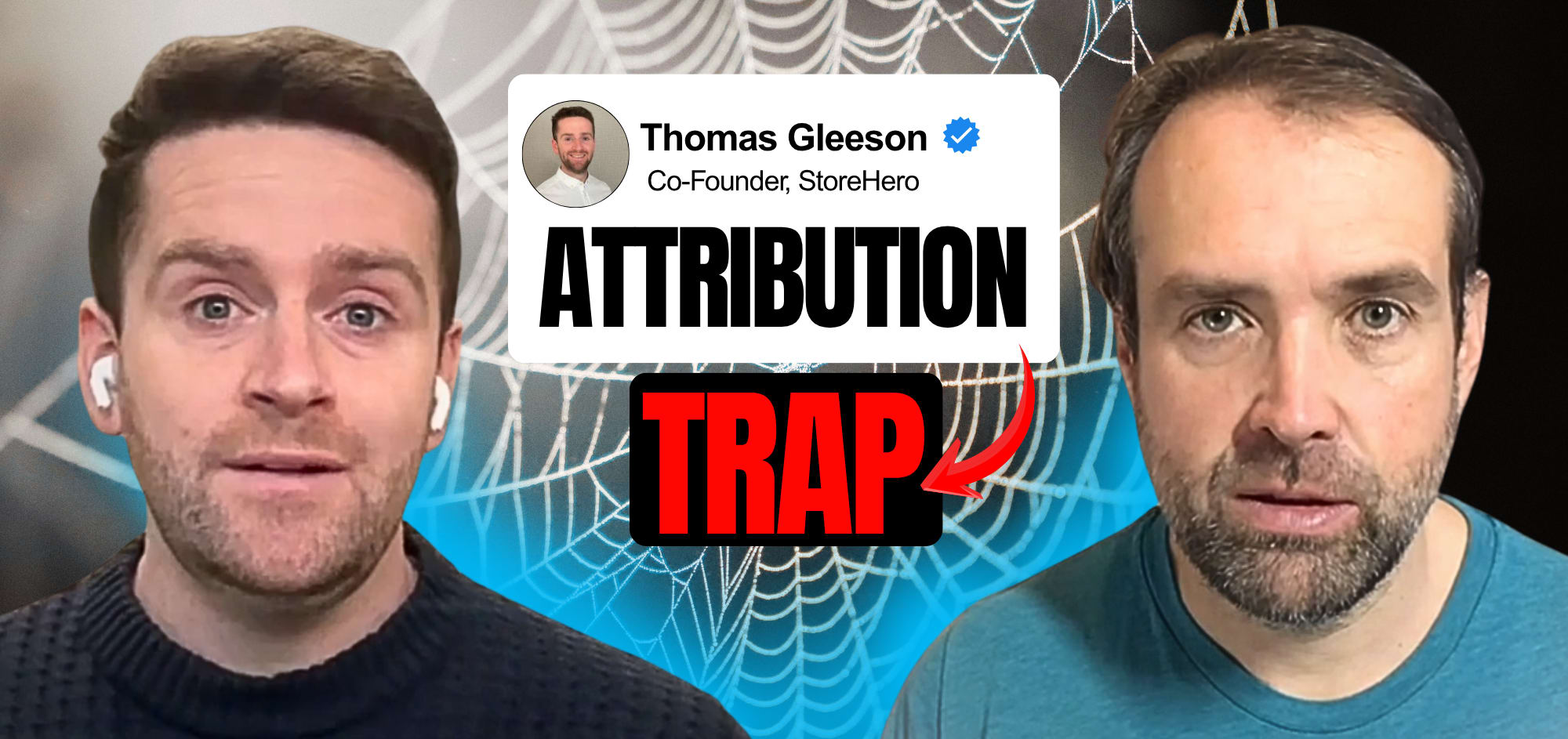
We sat down with Thomas Gleeson, co-founder of StoreHero, on the Littledata podcast to talk about why profit-first measurement has become the only stable way to scale paid media and what it takes to get there.
The story behind StoreHero (and why it matters)
Thomas’s origin story is surprisingly familiar.
He grew up in ecommerce through a family business, doing SEO from childhood, then discovered the Facebook Pixel around 2015 and finally had a ROAS number to point at. For a while, it was exciting. Then his dad, an accountant, asked the questions that always show up eventually.
Can Facebook and Google both claim the same sale? Are you counting VAT inside “revenue”? Where are product costs, shipping, labour, and fees in any of this?
His conclusion: “I have no confidence in these numbers. We’re pulling the budget.”
So Thomas built a spreadsheet with one weekly job: we spent X, did we generate more profit? That spreadsheet eventually became StoreHero and the lens through which he now critiques attribution-first reporting.
Why solving attribution does not solve the business
Attribution isn’t useless. But it has a fundamental problem: it’s subjective.
As Thomas put it: “You can get 20 different versions of attribution in any of these tools, and they’re all correct. They’re all right. But that doesn’t make your decision as a capital allocator within your business any easier.”
Pick a 7-day click window, a 28-day view-through, or anything in between. Each tells a different story. And the incentive structures around attribution make this worse. Performance agencies are typically paid on a percentage of ad spend. That means the version of attribution that shows the biggest numbers is also the version that justifies the biggest budgets.
Thomas recalls a fashion brand founder who did a high-profile collab with Noel Gallagher. Gallagher posted on Instagram, it went viral, and sales spiked. The paid media agency came back claiming they had driven most of those sales. The founder’s response: “That just can’t be true. Noel Gallagher versus Facebook!”
It probably wasn’t. But with the right attribution window, it looked that way.
As Ed noted during the conversation: even if you prove one channel is 10% better than another, you still end up spending across Meta and Google anyway. The bigger constraint is whether your unit economics justify scaling spend in the first place. Attribution doesn’t tell you that. Contribution margin (CM) does.
Five profit levers that stop marketing arguing with finance
1. Use ROAS as a diagnostic, not the decision
Attribution can be internally consistent. The numbers add up, the dashboard looks clean, and it still leads you into bad spend decisions. Because it doesn’t know your margin structure, and it’s highly sensitive to settings: attribution windows, models, platform bias.
Thomas saw this play out at a brand doing £25-30m a year. Their attribution tool showed great numbers every week. The business was bleeding money.
If ROAS is deciding your budget, you’re letting a marketing metric run a finance job.
2. Put contribution margin (CM) in the same room as marketing
This is Thomas’s core framework. The terminology sounds like accountancy bootcamp, but the concept is straightforward.
Contribution Margin 1: Revenue minus product costs only. This is not your gross margin, even though many brands treat it as such.
Contribution Margin 2: CM1 minus all variable fulfilment costs: shipping, 3PL, returns, discounts, transaction fees. Thomas calls these the “paper cuts”: every one feels small, but they stack fast. This is your true gross margin.
Contribution Margin 3: CM2 minus your total marketing spend. This is the number that tells you whether your growth is real.
The trap most brands fall into is treating CM1 as their gross margin and building their entire financial model on a number that’s already wrong before they’ve spent a penny on ads. Thomas saw it end a business: a brand forecast the year ahead on an assumed gross margin that turned out to be wrong. The agency hit every target. The business closed.
“Sometimes people hear the word contribution margin and think I’m sending them off to accountancy bootcamp for six weeks,” Thomas says. “We’re literally just trying to understand: did we spend more money? Did we make more money?”
You need to know your true margin after marketing in one sentence before you can scale spend confidently.
3. Make weekly profit your baseline metric
The simplest shift in the whole conversation: every week, ask two questions.
- How much did we spend on marketing?
- Did we generate more profit because of it?
That single discipline prevents two expensive mistakes: overspending because the dashboard tells a comforting story, and underspending because nobody trusts the data enough to push.
“If we don’t have that core fundamental piece first,” Thomas says, “it’s extremely difficult to confidently spend money and know that we’re making the right decisions every week.”
The goal isn’t perfect attribution. It’s confident allocation.
4. Use GA4 for behaviour. Use Shopify as your revenue ledger.
GA4, set up correctly, is genuinely useful: sessions, conversion rates, landing page performance, channel splits. It tells you why demand moves.
But finance needs a ledger, and that ledger is Shopify orders, with refunds, discounts, cancellations, shipping, and fees accounted for. Platform attribution dashboards don’t give you that. Neither does GA4 alone.
Thomas gave a clear example. A large influencer brand in LA was spending more year-on-year while revenue fell. Paid performance actually looked fine. The real issue was that the founder had stopped posting as much. Organic traffic’s share had dropped from around 55% to 20%. Nobody had spotted it because they were only watching paid dashboards.
Sometimes “paid is down” is a symptom. The cause might be organic decay, and you will not see it unless your data is accurate and complete.
This is where Littledata fits into the picture. Accurate, server-side data capture means your Shopify revenue figures are reliable in GA4 and across your marketing platforms. If your revenue data is off, your CM2 and CM3 calculations are off too, and profit-first reporting built on shaky data is just a different kind of guesswork. And with Profit Signal you can push contribution margin — not just revenue — into Meta and Google Ads, so the algorithms optimize for the customers who actually contribute profit.
5. If you’re on Shopify Markets, your reporting needs to reflect it
Shopify Markets makes operating globally easier and makes unit economics messier. FX, fee structures, regional pricing differences, returns by market, and often multiple ad accounts per region all start compounding.
Blended ROAS hides all of this. A market that looks profitable in aggregate might be quietly underwater in one region and over-indexed in another.
If you’re on Markets, you need country-level contribution views, or you risk scaling the wrong region.
The agency conversation worth having
One of the most important threads in this conversation is how the agency model is changing.
Many agencies are paid a percentage of ad spend, so “spend more” is always an easy recommendation and attribution can be configured to support it. But Thomas’s broader point is that the underlying service is getting commoditised. Meta and Google are pushing more automation through Advantage+ and Performance Max. The micro-optimisations that used to justify an agency retainer are increasingly handled by the platforms themselves.
What doesn’t get commoditised? Business strategy. Forecasting. Unit economics.
The best agencies Thomas sees right now are working backwards from financial objectives: sales target, fixed costs, profit objective, and then asking what you can afford to spend and what efficiency rate you need. They’re acting less like media buyers and more like business operators.
“The agencies that are absolutely smashing it are the ones who’ve recognised that. They are really heavily leaning into being that business consultant. Yeah, we do your paid media as well, but we are a business consultant.”
This shift is also showing up on the finance side. Thomas flagged the rise of fractional CFOs who specialise specifically in ecommerce, people who understand CAC payback windows, Meta overspend recovery, and cash conversion cycles in a way that a generalist accountant simply does not. For a founder whose biggest line item is now their marketing budget, having someone in that seat who actually speaks the language of paid media is increasingly the difference between confident spend decisions and expensive guesswork.
The bottom line
If marketing feels like it’s constantly defending itself to finance, it’s usually a measurement hierarchy problem.
Make Shopify your revenue ledger. Make contribution margin your budget constraint. Use attribution to steer, not to declare truth.
Attribution has its place. But it was never designed to answer the question every founder actually cares about: is this business profitable, and is our marketing making it more so?
Start with the profit number. Get your data foundation solid. Then layer in the attribution.
Not the other way around.
This post is based on a conversation with Thomas Gleeson of StoreHero on the Littledata podcast. You can watch the full episode: https://www.youtube.com/watch?v=PHlmrcn2CcI
Related reading