The New Shopify Growth Playbook: What Premium Brands Need to Know Right Now
by Edward

Acquisition costs are rising. Platform attribution is unreliable. AI is reshaping everything from creative production to customer service. The brands scaling well right now are not doing more of the same. They are measuring differently, spending differently, and building differently.
Ahead of the Pulse eCommerce Summit 2026, where Littledata is proud to be a sponsor, we sat down with Paul Rogers and Josh Duggan, Co-Founders of Vervaunt, to get their honest read on the state of ecommerce growth.
Paul leads on ecommerce technology, strategy and CRO. Josh leads on paid media, acquisition and creative. Together, they work with some of the most ambitious premium fashion and lifestyle brands in the UK and beyond.
Watch the full podcast here:

Their view: the playbook that built most of the successful DTC brands of the last decade is no longer enough. And a lot of brands have not caught up with that yet.
Paul and Josh will be opening Pulse on 13 May with their State of Commerce and Media session. These are the themes every ecommerce leader in that room should be thinking about.
Acquisition costs are rising and the old growth model is under pressure
For much of the last seven or eight years, the majority of ecommerce brands were growing year on year. Not always spectacularly. But consistently.
That changed.
Ad spend on Meta grew roughly 25% last year. Online consumer spending did not keep pace. The result is a market-wide rise in acquisition costs, squeezing returns that were never particularly wide for many brands.
What is interesting is how brands are responding.
The smarter ones are not simply cutting spend. They are becoming more deliberate about where they spend and what they expect in return. Less obsession with blended ROAS. More focus on profitability, unit economics and the real value of a new customer.
That is a healthy shift. But it only works if the measurement underneath it is actually reliable.
The KPI conversation is moving closer to commercial reality
One of the strongest ideas in the conversation was allowable new customer MER.
The phrase is a bit clunky. The concept is not.
Instead of asking what ROAS a campaign delivered, a brand asks: how much can we afford to spend to acquire a new customer in this market, for this product category, with this margin structure, this return rate and this long-term value?
That number changes by market. It changes by product. It changes by customer type.
A jacket buyer in Germany with a high return rate has a different allowable CAC from a skincare buyer in the UK with strong repeat purchase. Treating them as the same acquisition problem produces the wrong answer.
The brands that have moved to this model are also running geo-based incrementality tests to validate what is actually driving new customers, rather than relying on platform attribution to tell them. That is a meaningful shift. Platform numbers will always flatter the platform.
The practical implication is that Vervaunt’s primary stakeholder has moved. Their most important conversations are now with finance teams, not digital marketing managers. That alone tells you something about where ecommerce decision-making is heading.
Measurement needs to move beyond platform reporting
Google Analytics still has a role. For understanding on-site behaviour, monitoring funnel drop-off and segmenting traffic, it is useful.
As the primary source of truth for marketing investment decisions, it falls short.
The issue is not just attribution. It is data quality across the board. Platform pixels over-report. Last-click models miss brand influence. And as customer journeys become more fragmented, the gap between what the tools show and what is actually happening gets wider.
The brands getting this right are building a proper data foundation: a warehouse that connects purchase data, product-level economics, market context and paid media signals. Not because it is technically interesting. Because it is the only way to make commercial decisions with any confidence.
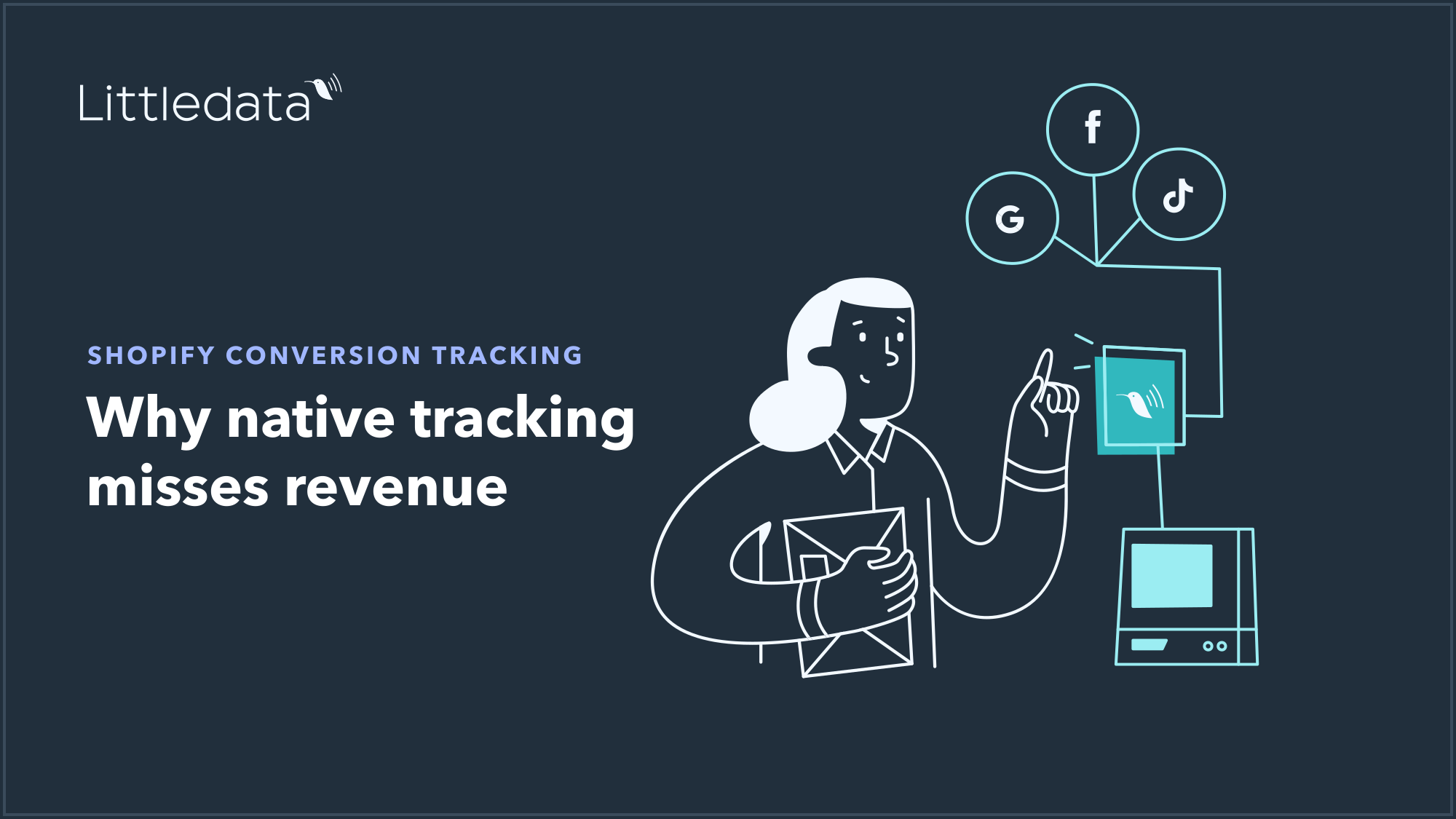
This is the problem Littledata exists to solve. Most Shopify brands are missing between 20% and 30% of their revenue in their analytics tools, not because the revenue is not real, but because a browser pixel never fired. Ad blockers, Apple’s Intelligent Tracking Prevention, accelerated checkouts, Shop Pay: all of these create gaps in standard client-side tracking. The revenue happens in Shopify. It simply never makes it back to Google, Meta or Klaviyo.
Littledata is the data layer for Shopify. It connects server-side Shopify signals directly to your ad platforms and marketing tools, so the data your algorithms learn from reflects what actually happened in your store. When Meta’s algorithm can see 20 to 30% more attributed conversions, its budget allocation and bidding decisions improve significantly. The same logic applies to Performance Max, to Klaviyo abandonment flows, to every system that depends on conversion signals to function well.
Incrementality testing, allowable CAC modelling, AI-assisted optimisation: none of it works on a weak signal. And the signal problem on Shopify is more common than most brands realise.
Read: Why Shopify Brands Are Flying Blind: And What a Data Layer Actually Does About It
Creative has become one of the most important signals in paid media
Josh’s sharpest observation was that creative has become today’s targeting.
That is especially true on Meta.
The old model: pick an audience, then build an ad for that audience.
The new model: give the platform a range of creative signals and let it find the right people. The ad itself tells the algorithm who it is for.
A product durability message attracts one type of buyer. A founder story attracts another. UGC, lifestyle imagery, sustainability content and premium campaign visuals all send different signals. The machine reads all of them.
That changes what a good creative strategy looks like.
It is not about producing more variations of the same idea. It is about testing genuinely different buying motivations and understanding which ones scale, at what cost, in which markets.
For a premium brand, that might mean testing craftsmanship, styling, founder story, social proof, seasonal relevance and category education as separate angles. Each has a ceiling. Each costs something to produce. Content production cost should be part of the performance conversation, not a separate line item.
Vervaunt has rebuilt their creative strategy offering around exactly this. The question is no longer just whether an ad worked. It is whether the creative route behind it is worth building a repeatable system around.
AI is already delivering value in practical places
There is a lot of noise around AI in ecommerce. Most of it is either overstated or pointed at the wrong things.
The practical wins, right now, are less glamorous than the headlines suggest.
Customer service automation is delivering real, measurable value. Tools like DigitalGenius and Gorgias are helping brands automate a meaningful proportion of queries while improving response times. That is a genuine win.
Copywriting, translation and product enrichment are also clear use cases. For brands with large catalogues, AI turns thin product data into richer descriptions, better attributes and more useful content at scale. The quality is good enough to act on.
Reporting is the third area worth watching. Vervaunt has spent the last 18 months building a data warehouse and connecting it to an LLM layer, so the team can query trends across clients, markets, product categories and creative types. That is AI making better analysis faster, not AI replacing judgment.
The areas that are still mostly noise: AI-generated creative imagery, where output quality is improving but brand trust is still limited; and AI-driven on-site personalisation, where the ambition is real but most brands are in a scrappy testing phase.
The pattern across all of it is the same. AI delivers value where the underlying data is clean, the use case is specific and there is a feedback loop to measure impact. Where data is messy and strategy is vague, AI amplifies the problem rather than solving it.
This is worth being direct about: AI running on corrupted data is worse than a competent human managing campaigns manually. The opportunity is not to adopt AI tools instead of fixing your data foundation. It is to fix your data foundation so that AI tools can actually do what they are designed to do. When Google’s algorithm knows with confidence which campaigns are driving revenue, not 70% of revenue but all of it, its ability to auto-optimise becomes genuinely powerful. When it is working from incomplete signal, it learns the wrong story and you scale the wrong things.
AI is changing the middle of the customer journey before measurement can catch up
One of the most useful parts of the conversation was about what AI is doing to the customer journey, not what it might do in the future.
The scenario is already familiar to anyone who has bought a considered product recently. You see an ad on Meta. You go to ChatGPT or Google AI Overviews to compare options. You check reviews elsewhere. You arrive at the brand’s site already decided. The attribution model records a direct visit. The paid ad gets no credit.
That is not hypothetical. It is showing up in the data. Traffic volumes are softening for some categories. Conversion rates are rising. The footprint of a pre-qualified buyer looks different from a browsing one.
This creates a real measurement problem. If your paid channels are driving consideration that converts later through a different touchpoint, last-click and even multi-touch models will tell you to cut the spend that is actually working.
The answer is not to find a new tool that claims to track the AI journey. It is to build the parts of measurement that survive a fragmented path: clean customer identity, server-side events, Shopify order data, and where possible, account-level matching that can stitch ad exposure to eventual purchase.
The brands that have that infrastructure in place will be much better positioned when the interface changes again, and it will change again.
International expansion is becoming easier to execute and harder to get strategically right
For Shopify brands, one area where the operational picture has genuinely improved is international expansion.
Five years ago, entering a new European market often meant a separate Shopify store, new integrations, local payment configuration, tax and duty complexity and a significant development project. The commercial case had to be strong to justify the lift.
That has changed. Shopify Markets, improved checkout localisation, better duty and tax tooling, and a more mature app ecosystem have absorbed much of that complexity. AI has made translation, product enrichment and content localisation faster and cheaper.
The operational barrier is lower. Which means the commercial question matters more, not less.
Which market is actually worth entering? Which products should lead? What does profitable acquisition look like in each market, once you account for returns, duties, currency, repeat purchase and local competition?
Shopify has simplified the how. The brands that get international expansion right are the ones who have answered the why with real commercial rigour.
Read: How bad data is shrinking your Shopify market
The next advantage is a cleaner feedback loop
The big thread running through the conversation with Paul and Josh is that ecommerce is becoming more integrated.
AI will automate more tasks. Shopify will simplify more infrastructure. Ad platforms will keep absorbing manual optimisation.
That does not make strategy less important. It makes weak strategy easier to expose.
If your creative is generic, AI helps you make more generic creative faster. If your data is wrong, automation helps you act on the wrong signal at scale. If your KPIs are too shallow, you will scale what looks efficient and miss what is actually profitable.
The brands performing well right now are not the ones with the most ads, tools or dashboards. They are the ones with the clearest view of what is working and why. Cleaner data. Better commercial questions. Faster decisions.
Once the mechanical work is automated, the advantage moves to the teams that can see clearly and act on the right signal.
That is the conversation Littledata and Vervaunt are both in. Vervaunt brings the commercial strategy, the creative judgment, and the growth expertise. Littledata sits underneath it as the data layer for Shopify, ensuring the signals that feed your ad platforms, your analytics, and your automation are accurate, complete, and built server-side from Shopify’s source of truth. The strategy only works as well as the data it runs on. And it is exactly what Paul and Josh will be opening Pulse with on 13 May.
Join us at Pulse eCommerce Summit 2026
Littledata is proud to sponsor Pulse, the UK’s largest ecommerce conference for brands, run by our friends at Vervaunt. Paul Rogers and Josh Duggan open the summit on 13 May with their State of Commerce and Media session. With 1,800+ attendees, 70+ sessions and speakers from some of the most ambitious brands in the world, it is where the ecommerce conversations that actually matter are happening.
13–14 May 2026 | The Brewery, London | pulse.vervaunt.com