Meta Attribution in 2026: What Business Owners and Senior Leaders Need to Know
by Edward

The CEO’s summary – you’re busy and want the tldr version so here it is:
- Meta reports on sales that have happened when an ad was shown but not clicked
- As a result, channel performance looks inflated and doesn’t drop through to Shopify store sales and P&L
- Lack of audience segmentation also makes this issue worse as ads are shown to existing or lapsed customers who were likely to come and buy anyway, making new customer focused activity look like it’s performing when it isn’t
- These issues are easily rectified by focusing the algorithm on click based conversions and having diligent audience segmentation in place
- This means that incremental revenue is driven as the algorithm is fully focused on new to brand customers in top of funnel activity where the majority is spent
The full version
Let’s define the problem.
And there is a problem when it comes to Meta ads.
If you’re a CEO, founder or senior leader, this might sound familiar.
Meta says your revenue and ROAS are incredible. So naturally, you increase spend. You scale what’s working. The numbers inside Ads Manager look strong, sometimes stronger than ever.
Then the end of the month comes.
And the extra spend hasn’t translated into higher turnover. Shopify sales don’t feel meaningfully higher. Cash flow isn’t materially stronger. The P&L certainly doesn’t reflect the uplift the ad account promised.
We see this issue (to varying degrees) every time we do an audit. There is often a clear disconnect between what Meta reports and what the business actually experiences commercially.
The good news is that it’s fairly easy to correct.
You don’t need to become technical to understand this. And you don’t need to get lost in complex attribution debates. What you need is clarity on what’s actually being measured, and the confidence to ask the right questions of your agency or internal team.
Because if you can’t rely on the numbers inside the ad account, what exactly are you scaling?
What’s Actually Going Wrong?
In most cases, the root cause isn’t a lack of tools. It isn’t that you need some completely new system. It usually sits inside the campaign setup itself.
Meta reports conversions in two slightly different ways, but by default, those numbers are bundled together under one umbrella. So that’s where the distortion begins.
There are two types of conversions in Meta ads: click conversions and view conversions.
A click conversion is what most business owners assume is happening. Someone sees your ad, clicks it, lands on your website and buys.
That sale is tracked against the campaign. It’s logical and easy to understand. If you scale spend and click conversions increase, you’d expect revenue to increase too.
The second type is where things get murkier.
A view conversion happens when someone is served your ad in their feed, doesn’t click it, but later purchases from your website.
Meta counts that full sale against the campaign. That revenue feeds into ROAS, conversion rate, customer acquisition cost and overall performance reporting – even though there was no direct interaction.
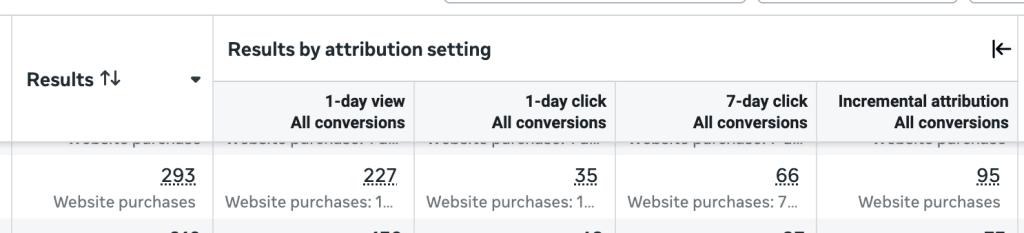
We can see in this example, total reported sales at campaign level were 293, incremental attribution is predicting that only 95 were likely directly as a result of an ad being served. Note the correlation between the click based sales and the incremental attribution reported figure.
Now, it is possible, for example, that someone sees an ad, remembers the brand, later Googles it and makes a purchase. That does happen.
But is it happening at the scale that justifies dramatically inflated ROAS figures? In most cases, no.
What’s far more common is that Meta is taking credit for sales that were already likely to happen, especially when existing customers or highly engaged users are involved.
And this is where it becomes more than just a reporting issue.
The Algorithm Is Learning From This
Meta doesn’t just report results – it optimises based on them.
We’re working with algorithms. That means ‘rubbish in, rubbish out’, the quality of the signals fed into the system, directly impacts what it does next.
If the algorithm sees lots of “sales,” even if many of them are view-through conversions or repeat purchases from existing customers, it believes it’s doing a good job. So it doubles down.
It will lean towards the lowest-risk users to bid on:
- Existing customers
- People who have already visited the site
- Users highly likely to buy anyway
To the algorithm, a sale is a sale.
But to your business, not all sales are equal.
If your “new customer” campaign is actually being inflated by repeat purchases and view-through attribution, the algorithm is being trained to optimise for the wrong thing. It’s chasing easy wins, not genuine growth.
Where It Gets Compounded: Audience Segmentation
This problem becomes even more pronounced when audience segmentation isn’t clean.
In many accounts, existing customers, engaged website visitors and true new-to-brand users aren’t properly separated. They sit inside the same campaign structure.
We can see here a ‘top of funnel’ campaign is picking up sales from existing customers and engaged users haven’t been defined so a likely proportion of reported new customer sales won’t be what they’re labelled as.

What then happens is fairly predictable. An existing customer is served an ad. They don’t click it. They reorder (which is especially common with consumable products). Meta records a sale.
Suddenly your new customer campaign looks incredibly efficient.
But the business hasn’t actually grown.
There’s nothing wrong with running campaigns to lapsed customers or remarketing to engaged visitors. In fact, that’s smart. But they should be structured intentionally, with their own budgets, messaging and expectations.
What you don’t want is inflated ROAS inside the campaign that’s supposed to be driving new business acquisition. Those campaigns typically carry the largest budgets and the greatest responsibility for growth. They need the cleanest signals.
The Simple Fix: 7-Day Click Only
One of the most effective ways to address this issue is surprisingly simple.
Optimise your campaigns for 7-day click only.
This removes view-through conversions from the optimisation signal. It ensures that only purchases driven by someone who actually clicked the ad are fed back into the algorithm.
When you do this, something interesting happens.
If you scale spend, you start to feel it in Shopify. Store sales move more closely in line with reported performance. The P&L begins to reflect what Ads Manager is saying. The disconnect reduces significantly.
You can still see view-through conversions in reporting if you want to compare. They don’t disappear. But they’re no longer being used as the primary feedback loop.
Now the system is learning from what we actually care about: new users who saw an ad, clicked it and bought. That’s what scales properly.
Yes, Your ROAS Will Drop
When you make this change, reported ROAS will almost certainly look lower than you’re used to.
That can be uncomfortable.
But now you’re working with cleaner data. And once you’re working with real signals, you can fix the real issues.
Often, the next step isn’t more budget – it’s better creative. Or bespoke landing pages designed specifically for first-time buyers. Or bundled introductory offers that improve new customer conversion rate.
Once you establish a viable, real conversion rate using clean data, you can scale with confidence. And when you do, you’ll start to see correlation across Shopify, GA4 and even brand search performance in Google Ads.
Not just inside Meta.
It’s Not About Perfect Attribution
Nobody has perfect measurement in GA4. There will always be some overlap between channels. Attribution will never be flawless.
This isn’t about perfection.
It’s about removing the biggest distortions so you can make meaningful commercial decisions and scale what genuinely works.
Incremental Attribution: A Useful Cross-Check
Meta’s incremental attribution update in 2025 added an extra layer of transparency.
It predicts how many sales would have likely occurred directly because the ad was shown.
When you compare incremental attribution to 7-day click performance, they often align closely (see the screenshot for a solid example). Meanwhile, view-through numbers can look wildly different.
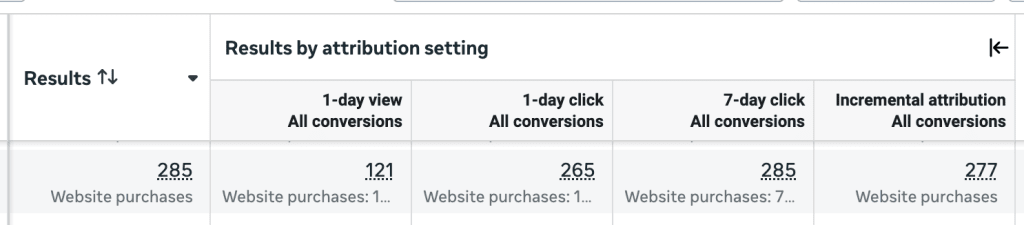
That alignment gives you a useful sense check. If click-based results match predicted incremental lift, you’re probably driving real-world impact.
And that’s ultimately what matters.
The Final Piece: Data Clarity and Server-Side Tracking
When you switch to 7-day click only, you’ll initially see fewer purchase signals entering the algorithm. Learning can be slower. It may take more time and spend to stabilise performance.
That’s because you’ve removed inflated signals and are now relying on cleaner, stricter data.
From a commercial perspective, this requires patience and a solid tracking foundation.
This is where server-side tracking becomes critical.
Server-side tracking improves Meta tracking by sharing customer actions directly from Shopify’s servers, bypassing browser-based pixel limitations. This method increases the Event Match Quality (EMQ) score by sending more reliable first-party data, such as hashed customer details and persistent identifiers like fbp and fbc cookies.
Littledata server-side tracking improves Meta ads by enabling the clear distinction between “New Customer Purchase” and “Returning Customer Purchase”. By feeding Meta this specific info directly from Shopify, advertisers can move beyond general purchase and optimize campaigns specifically for new customer acquisition or repeat buyer retention.
Ultimately, this leads to more effective ad spend that translates into real growth and new customer acquisition.
Looking for a more commercial approach to Google and Meta ads? We want to speak to you, let’s talk about your business.
This blog was authored by Byron Marr, Founder of ProfitSpring.