Shopify data into Twilio Segment: Markets context and EU routing
by Edward

Twilio Segment works best when it’s fed one consistent customer journey. But Shopify to Segment is where that journey often breaks.
The issue is that Shopify isn’t a normal website. It’s the operating system of ecommerce.
Shopify brands run into three recurring problems once they try to operationalise Segment:
- Data residency and compliance: “Where is this data being processed?”
- International complexity: “Which market did this happen in?”
- Setup and maintainability: “Can we keep this working as Shopify evolves?”
Over the last few releases, we’ve focused on these exact pain points — and the result is a Shopify → Segment connection that’s easier to trust, easier to manage, and more useful as you grow.
1) Regional Segment support: Meeting EU data residency requirements
To fully comply with EU data residency requirements, your biggest question is: “Can we process Shopify event data through EU servers consistently?”
Segment’s regional ingestion exists because some companies need event collection to align with their EU hosting, including how data is processed and how failover behaves.
How Littledata supports EU data residency
Shopify event streams sent to Segment (in both device and cloud mode) can be aligned with your Segment workspace region, whether that is EU or US.
What does this look like for a real Shopify brand?
Imagine a German Shopify brand with:
- EU customers
- An EU-based data warehouse (e.g., BigQuery/Snowflake in the EU region)
- Internal policy that customer data should not be routed outside the region
With Littledata, they can use Segment’s European data centers to relay Shopify event data onward to their EU data warehouse thereby keeping governance and architecture aligned with how they’re required to operate.
2) Shopify Markets support: Segmenting customer data within workspaces or across workspaces
Shopify Markets is now the default operating model for international brands.
You’re no longer running multiple country stores with their own customers and tracking.
You’re managing one global store with:
- Multiple countries, currencies, and pricing strategies
- Market-specific campaigns
- Market-specific lifecycle journeys and merchandising
But most Segment implementations still produce an event stream that’s missing a critical piece of context: “Which market did this happen in?”
When that market context is missing, teams end up doing awkward workarounds:
- Reverse-engineering market from raw events in the data warehouse
- Replicating market-based routing rules across each destination
- Building buggy audiences based on URL, browser locale or language
How Littledata supports Shopify Markets
Every event on every Shopify Market includes market context (identifiers like market_handle and market_id). That means you can segment, route, and filter inside Segment in a way that matches how your business actually runs internationally.
What does this look like for a real Shopify brand?
Let’s take a brand operating in three markets: DE, FR, and ROW.
They want Segment to drive:
- Local ad accounts in Germany and France
- Market-specific lifecycle flows
- One global data warehouse, but split by market
With Littledata they can set up:
- A different Facebook Ad account in Germany vs France, with different Meta Pixels.
- One Klaviyo account, but with German flows only triggering for German store customers
- One BigQuery instance with a market_handle for each event
And with market context on all events, they can build audiences like:
- “High-intent sessions in DE”
- “Repeat customers in FR”
- “ROW visitors who viewed Product X but didn’t purchase”

You can read more about how Shopify Markets work with Littledata.

3) Embedded Shopify app: Making the Shopify source easier to own
The Shopify → Segment setup only breaks when ownership and maintenance get messy.
So one of the most important improvements we’ve made is making the Segment connection Shopify-native and manageable inside the Shopify admin, where ecommerce teams already work.
Learn how to enable Littledata app embed in Shopify.

How Littledata supports Shopify setup
A deeper, embedded Shopify app experience for configuring and managing the Segment connection, with a clearer “Is this working?” experience.
What does this look like for a real Shopify brand?
Imagine a lean growth team running Shopify plus a handful of destinations through Segment.
They don’t want to open a ticket every time something changes.
They want:
- A place in Shopify to confirm the connection is healthy
- Clarity on what events are being sent
- Fewer “mystery gaps” during platform changes
A Shopify-native configuration experience reduces time-to-value during onboarding, and reduces operational risk later — which is exactly what matters if Segment is powering many downstream systems.
What’s next: Event customizer for more flexibility without custom pipelines
Once the basics are right, i.e., reliable purchase and identity signals flow into Segment, the next challenge is a richer context.
Not just “Product Viewed”
But:
- Product viewed of product tagged as ‘new’
- Product viewed by customer in VIP loyalty tier
- Product viewed of product with more than 10 reviews and more than 4.5 rating
- Consistent mapping rules that work across all Segment destinations
That’s what Littledata’s Event Customizer is designed for: more flexibility in how event properties are mapped and enriched before they hit Segment destinations.
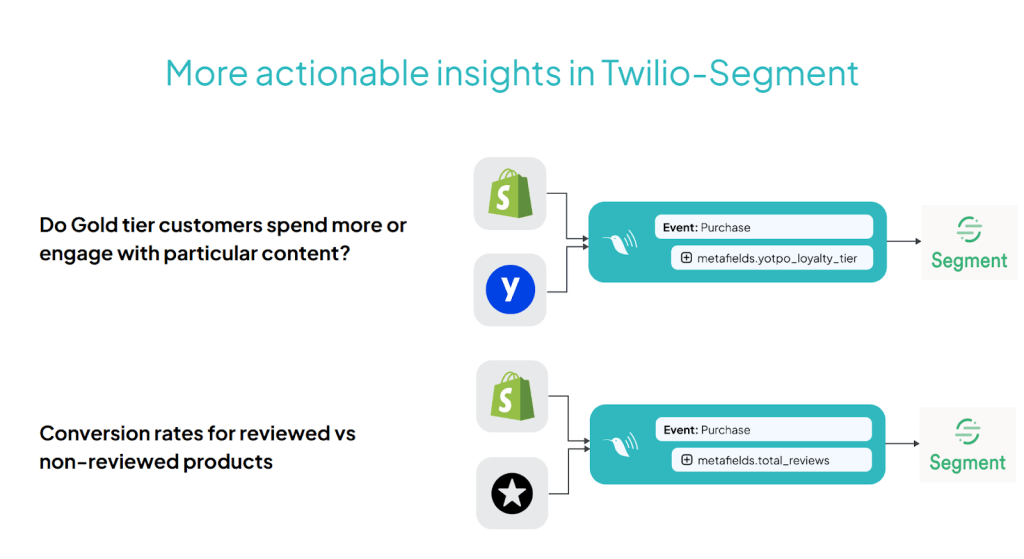
In practical terms, this direction enables teams to:
- Enrich events with additional customer/product context
- Create “synthetic” events that are closer to business meaning
- Filter event noise so downstream tools receive what matters
The goal is simple: Shopify already knows a lot of truth about customers, products, and orders. So teams should be able to make that truth available in Segment without a data engineering project.
Segment becomes more valuable when Shopify becomes a deeper source
Segment’s promise is compelling: one clean source in, many consistent destinations out.
For Shopify brands, the fastest way to realise that promise is rarely “add another tool.”
It’s making sure Shopify is feeding Segment a customer story you can rely on across regions, markets, and day-to-day reality of running commerce.
That’s what these updates are about:
- Aligning Shopify events with regional requirements
- Making Markets context first-class for segmentation and routing
- Reducing operational friction by managing the connection inside Shopify, and
- Opening the door to richer enrichment as needs evolve
If Segment is how your team scales activation, measurement, and identity across tools, then getting Shopify right upstream is one of the highest-leverage improvements you can make.