Why Klaviyo flows miss revenue on Shopify: The data problems most brands overlook
by Edward

Most Shopify brands think they have a flow problem.
They have a signal problem.
When browse abandonment underperforms, cart recovery feels patchy, or retention revenue stalls, the instinct is usually to tweak copy, add more branches, or build another automation. But most of the time, the bigger issue sits upstream.
Klaviyo can only act on the data it receives.
So if product views are missed, carts are not reliably captured, or shoppers stay anonymous until too late, your flows are working with partial truth. And partial truth has consequences; it limits who enters the flow, when they enter, and how relevant the message feels when it arrives.
That matters more now because retention is no longer a “nice to have” lever. As acquisition gets more expensive and less predictable, more of the margin story depends on getting existing customers to come back.
That is why the best place to start is with the data feeding your Klaviyo flows.
Why does retention matter more for Shopify brands right now?

Email and SMS have become easier to deploy over the last few years. What has not become easier is giving those channels clean enough data to work with.
That is the shift. Retention is more important. But the quality of data behind retention is increasingly what separates brands that scale email revenue from those that plateau.
Rising CAC, tighter attribution, and more competition in paid channels mean retention is doing more of the economic heavy lifting. Repeat purchases are where brands earn back acquisition costs, protect margin, and build more resilient growth.
What data does Klaviyo actually need to perform well?
To make flows timely and relevant, Klaviyo needs a usable picture of what someone did before purchase. That includes product views, add-to-cart events, checkout behaviour, and a way to connect those actions to a known profile.
It also needs context. What was in the cart? What was the value? Was the shopper just below a free shipping threshold? Which product or category were they engaging with? The richer the event data, the more precise the message can be.
The key point is simple: retention gets stronger when Klaviyo can recognise intent before the order, not just record the order after it happens.
Which Klaviyo flows usually matter most?
Usually, not that many.
A lot of brands assume lifecycle maturity means building dozens of flows. In reality, most revenue comes from a compact core. Welcome flows matter, but browse abandonment, cart abandonment, and checkout abandonment are often among the biggest contributors.
The goal is not to create endless automation. It is to make the high-intent flows fire more reliably for more of the right people.
→ Read: The ultimate guide to Klaviyo flows
Why do abandonment flows fail to trigger reliably?
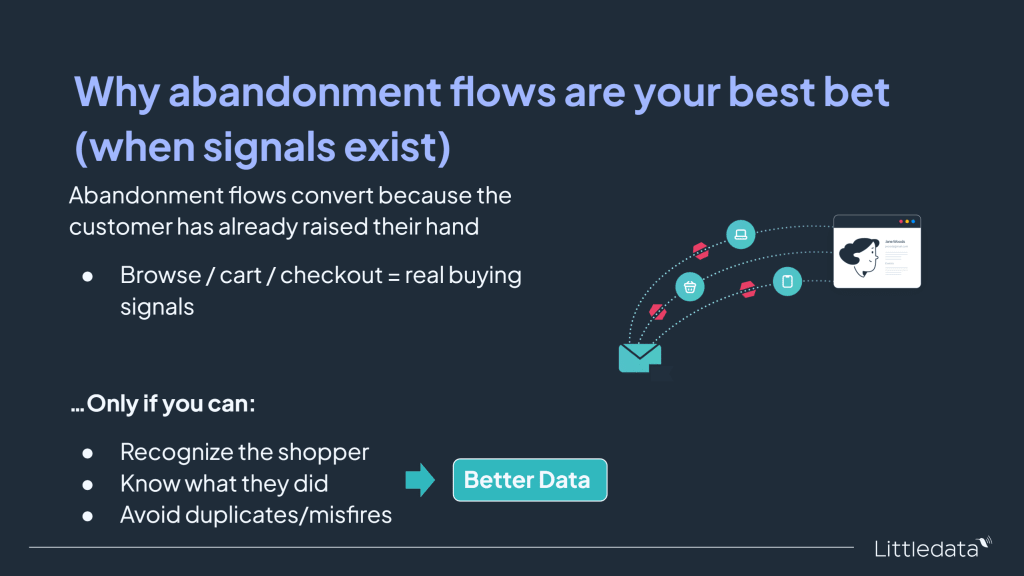
Because the signal breaks before the automation starts.
This is where many Shopify brands get caught. They think the flow is weak, when the real issue is that too few shoppers are making it into the flow at all.
Browser-side tracking has become less dependable. Cookie consent reduces coverage. Safari limits tracking. Ad blockers and privacy tools suppress scripts. And even when an event fires, Klaviyo still needs to match it to a known profile, and that identification step fails more often than brands realise.
So the customer intent is real. The platform just does not always get a complete version of it.
That is why abandonment flows often feel weaker than they should. The sequence may be fine. The audience entering it is the problem.
→ Know why your web analytics are broken (and how to fix them)
What does “better data” actually mean for retention?

It means more recognised shoppers, richer events, and fewer blind spots.
In practice, that looks like server-side identity resolution, server-side product and cart events, and a stronger connection between browsing behaviour and customer profiles. It means Klaviyo can see more of what happened and act on it with more confidence.
One of the most obvious examples is suppression. If someone has already completed a purchase, they should not receive an abandonment email five minutes later. That sounds basic, but it still happens when signals arrive late or inconsistently.
Better data is not just about more volume. It is about cleaner timing and better trust.
→ Learn how to double your Klaviyo flow performance with server-side triggers for email and SMS

Why is server-side tracking such a big deal for Klaviyo?
Because client-side tracking misses too much.
If you depend on scripts in the browser, there are too many ways for the signal to fail. Someone switches devices. A browser restricts cookies. A thank-you-page tag does not fire. An ad blocker interrupts the chain. Suddenly the flow logic is working from an incomplete record.
Server-side tracking ensures key events are captured and stitched back to the customer correctly, even when the browser can’t. That helps Klaviyo trigger more flows, suppress more accurately, and build more reliable profile histories over time.
And this is not only a retention issue. The same missing data can affect how Meta and Google learn from conversions. So when the signal is weak, you are not just making the lifecycle worse. You are also training ad platforms on a messier version of reality.
→ Find out if you’re unknowingly paying Meta to “acquire” customers who would have bought anyway
Can better retention data increase flow revenue without changing the emails?
Yes. Often that is the first win.
Brands usually look at poor flow performance and assume the message needs rewriting. Sometimes it does. But if the main issue is that too few high-intent shoppers are entering the flow, better data alone can lift results.
That is the lever most brands skip.
If more shoppers are recognised, if more browse and cart events are captured, and if purchase suppression works properly, you expand the reachable audience without touching the creative.
The email did not suddenly become smarter. The trigger just became more truthful.
Can retention data also improve acquisition efficiency?
Yes, especially when you separate new and returning customer signals.
If Meta or Google optimise against one blended purchase event, they can end up finding easy wins among existing customers and retargeting-heavy behaviour. That inflates confidence without always creating incremental growth.
A cleaner model is to split conversions between new-customer purchases and returning-customer purchases. Then prospecting can optimise around net-new buyers, while returning customers are handled through lower-cost retention channels and different paid strategies.
That keeps acquisition more honest and retention more efficient.
What should Shopify brands fix first?
Start with a simple audit:
- Are you reliably capturing product views, add to cart, checkout started, and purchase?
- How many subscribers can actually be identified before they purchase?
- Are your abandonment flows missing people, or firing too late?
- Can your paid channels distinguish between new and returning customers?
Do that before you build more branches, add more segmentation, or write more email copy.
Because most brands do not need more automation first. They need better truth.
And when the truth improves, Klaviyo usually gets better with it.