Why Shopify Brands Are Flying Blind: And What a Data Layer Actually Does About It
by Edward

If you run a Shopify store and you’ve ever pulled up Google Analytics, then opened Meta Ads Manager, then glanced at your Shopify dashboard, you’ve probably experienced that unsettling moment where all three show different numbers. Different revenue. Different conversion counts. All for the same time period, the same business, the same customers.
Most brands are told to accept a 20% discrepancy as normal. I’d argue that’s 20% of your marketing decisions being made on data you fundamentally cannot trust.
This isn’t a minor inconvenience. It’s the kind of signal corruption that quietly costs you money every single month.

The Real Reason Your Numbers Don’t Match
The root cause is something almost no one talks about plainly: client-side tracking.
Google Analytics only knows a purchase happened because a small ping fires from your thank you page to Google’s servers. That’s it. If that ping gets blocked by an ad blocker, Apple’s Intelligent Tracking Prevention, a slow connection, or a customer closing the tab before the page fully loads, the revenue is simply never recorded. It vanishes from your data without a trace.
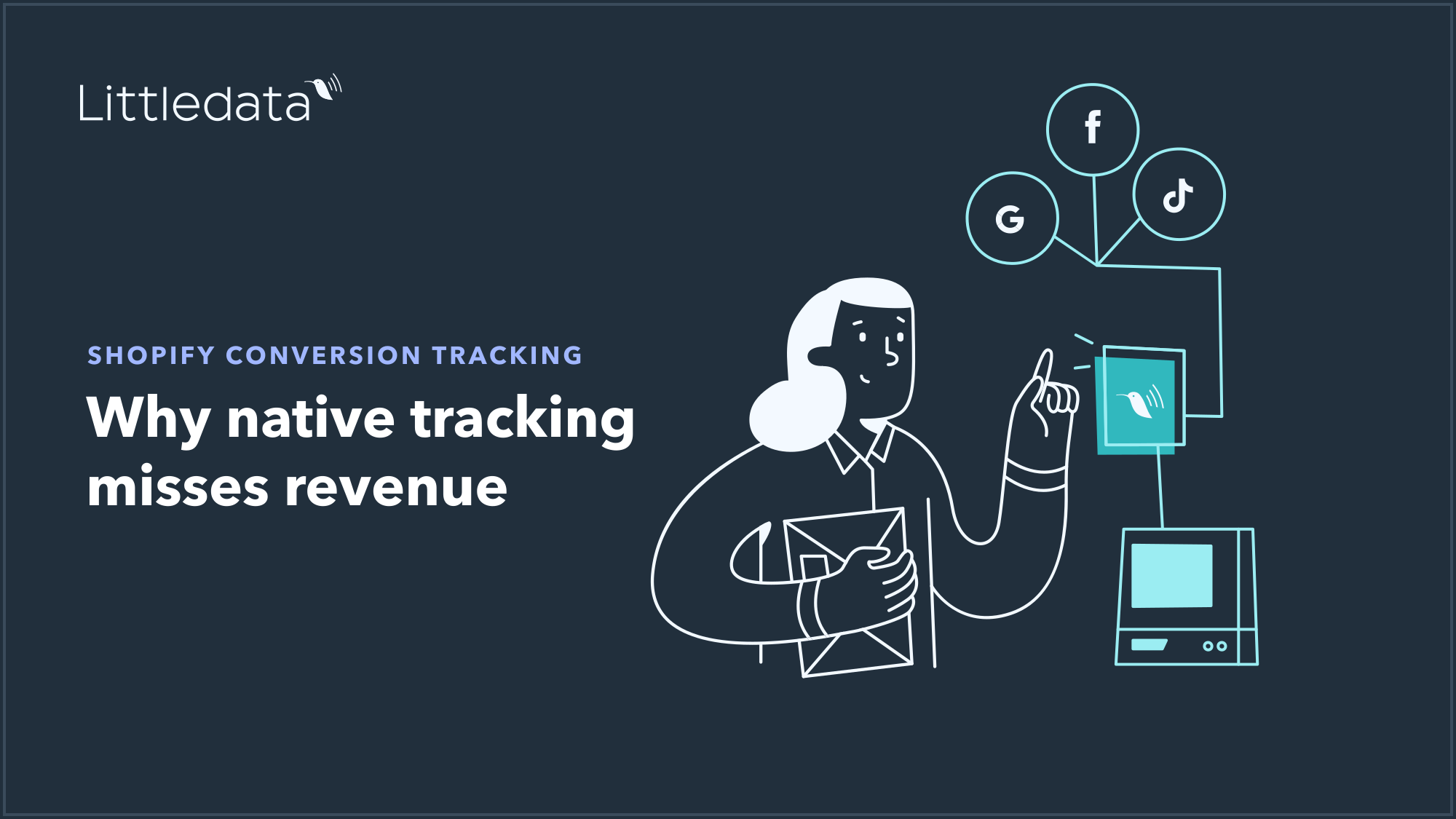
This is the uncomfortable truth: in modern ecommerce, the thank you page is increasingly unreliable as a tracking mechanism. Headless builds, accelerated checkouts, Shop Pay, TikTok Shop: all of these introduce gaps in the standard client-side tracking model. Most stores are missing between 20% and 30% of their revenue in their analytics tools, not because the revenue isn’t real, but because the ping never arrived.
The fix isn’t clever workarounds inside Google Analytics. The fix is a direct, server-to-server integration between Shopify and every marketing channel you care about. Every order relayed directly, uninterrupted, not dependent on a pixel firing, not affected by browser privacy settings, not impacted by consent banners.
What a Data Layer Actually Is
The term “data layer” sounds technical, and in some circles it conjures images of complex Google Tag Manager configurations. That’s not how we think about it at Littledata.
A data layer is the consistent, reliable layer between your commerce platform and your marketing channels. Its job is to ensure that the same events (product views, add to carts, checkouts, purchases) carry exactly the same customer and product properties everywhere they’re sent. Not “roughly similar.” Identical.
This matters because inconsistency between channels doesn’t just cause reporting headaches. It actively degrades the performance of the algorithms you’re relying on to grow your business.
Think about Meta’s algorithm for a moment. It’s designed to find the creative, placement, and audience combination most likely to drive a purchase. But its ability to do that optimization depends entirely on the quality of the signal you’re feeding it. Meta calls this your Event Match Quality score: essentially, how well they can tie a purchase event back to a person in their ad network.
If your event match quality is low, Meta can’t reliably attribute conversions to the right creative. Its budget allocation becomes guesswork. You might have two ad creatives that are genuinely performing at parity, but because one has slightly better attribution, Meta reads it as twice as effective and routes 90% of your budget there. The result is a self-fulfilling optimization loop built on faulty inputs.
Better data doesn’t just improve your reporting. It improves the actual outcomes your ad spend produces.
Meta, Google, and Klaviyo: What Actually Changes
Let me walk through what happens channel by channel when accurate server-side data starts flowing.
Meta
The free Facebook and Instagram app that Shopify ships with does use the Conversions API. But it’s missing critical detail, both in terms of funnel coverage (abandoned cart and checkout events often go untracked) and in terms of the identifiers needed to match events back to users. Email, phone number, IP address, external ID: all of these contribute to event match quality.
Beyond just improving attribution on web orders, server-side integration unlocks something more powerful: the ability to feed offline and cross-channel orders back to Meta with customer identifiers attached. If someone sees your Instagram ad and buys through your retail store, your Amazon listing, or your TikTok Shop, Meta has no way of knowing it drove that sale unless you tell it. With a full data layer, you can. And that has a material impact on your true return on ad spend, which is almost always being underestimated if you’re only attributing web orders.
Google’s equivalent is called Enhanced Conversions. The “enhanced” part means attaching customer data (email, physical address, phone number) to the conversion event so Google can match it back through its device graph. The result is the same as with Meta: more accurate attribution means smarter auto-optimization of Performance Max campaigns. Brands consistently find that when Google can see 20-30% more attributed conversions, its budget allocation and bidding decisions improve significantly.
Klaviyo
Klaviyo already does a reasonable job of tracking Shopify events, but there are two areas where a data layer meaningfully improves performance.
First, customer identification. Klaviyo can only trigger an abandonment flow if it knows who is on your storefront right now. A data layer joins the dots between your Klaviyo contact list and live browsing behaviour, so when someone on your email list visits a product page or adds to cart, Klaviyo knows it’s them and can act on it immediately. In practice, this means triggering 50 to 100% more abandonment flow emails compared to what Klaviyo’s default tracking would catch.
Second, those abandonment flows then feed better identity data back to your ad channels. If we know this person’s email from Klaviyo, we can pass it to Meta and Google as part of the conversion event. It’s a compounding effect: better Klaviyo triggers, better ad attribution, better algorithmic performance, all from the same underlying data.
The results aren’t theoretical. Skinfix, working with agency Verbal and Visual, saw 150% more revenue from checkout abandonment flows and nearly 400% more from browse abandonment flows after implementing this approach. Better data combined with intelligent implementation.
The Agency Angle
For design and build agencies, server-side data infrastructure is a painkiller. The alternative, building and maintaining a custom server-side Google Tag Manager setup, is fragile, expensive to maintain, and inevitably generates client complaints when things break or fire twice. It doesn’t need to be that hard.
For performance marketing agencies, accurate attribution makes you look better to clients and enables more sophisticated tactics: new customer acquisition campaigns that specifically exclude existing customers, audience segments built from subscription versus one-time purchasers, retargeting audiences that actually reflect who’s been on the storefront recently rather than who visited 60 days ago.
For retention marketing agencies, it’s a clean uplift on top of whatever flows you’ve already built. The copy, creative, and strategy stay yours. The data layer just ensures more of those flows fire when they should.
AI Optimization Needs Accurate Signal
There’s a lot of conversation in the industry right now about AI-powered campaign optimization. Google and Meta are both investing heavily in tools that automate creative selection, audience targeting, and budget allocation.
I’m genuinely excited about where this is going. But I want to be clear about something: AI running on corrupted data is worse than a competent human managing campaigns manually. The optimization loops these systems rely on are only as good as the feedback signal you’re providing.
The opportunity isn’t to adopt AI tools instead of fixing your data foundation. It’s to fix your data foundation so that AI tools can actually do what they’re designed to do. When Google’s algorithm knows with confidence which campaigns are driving revenue (not just 70% of revenue, all of it), its ability to auto-optimize becomes genuinely powerful.
The same logic applies to the emerging AI analytics interfaces, including Google’s own conversational layer for Google Analytics and tools like Triple Whale or Polar. A chat interface over bad data answers your questions incorrectly. A chat interface over clean data actually helps you make decisions.
What’s Coming
A few things worth knowing if you’re evaluating your data infrastructure now.
Shopify Markets support is arriving this month. Brands moving to Markets for multi-region management often find that their standard ad integrations collapse everything into a single ad account, making it impossible to manage by market. Full Markets support means separate pipeline rules, filtering, and ad account routing per market, and proper segmentation in Klaviyo and Google Analytics by region or storefront type.
Microsoft Ads integration is coming next month. Bing has seen a resurgence through its OpenAI partnership, and the native Shopify integration is, frankly, not fit for purpose. If you’re spending on Microsoft Ads, clean server-side data matters just as much there as anywhere else.
The Event Customizer is a longer-term feature that will allow brands to configure their own custom events, so rather than sending Klaviyo the standard lifecycle events, you’ll be able to trigger flows based on highly specific behavioural combinations: purchased once in a particular category, then viewed a product in another category. Fine-grained control over what gets sent where, without code.
Getting Started
The install itself takes about 10 minutes. No developer required, no theme code changes. An app embed, a customer event on checkout, and you authorize your ad channels from there. The complexity lives under the hood, not in the setup process.
There’s a 30-day free trial for all new customers, which is intentional: these data improvements are often subtle at first glance. You don’t always see the gap until you start measuring what was missing. A month gives you enough signal to be genuinely certain of the improvement in data quality before committing.
If your GA revenue doesn’t match Shopify, if Meta is claiming credit for sales that came from email, if you’re not confident your ad algorithms have the signal they need to optimize, that’s the problem a data layer solves.
Start at littledata.io.